
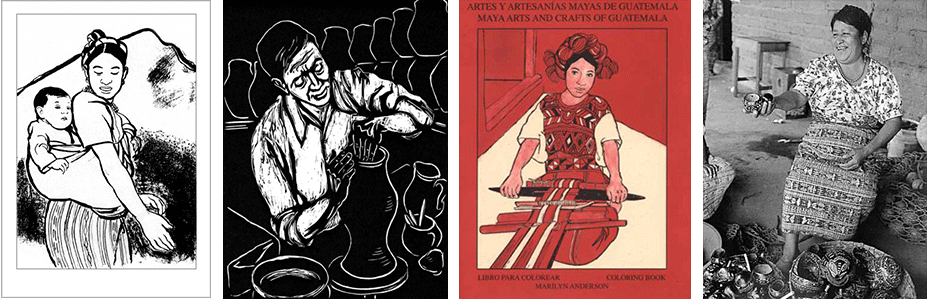
During the 2010 hurricane season, all proceeds from sales of prints in my series Maya Artists and Artisans of Guatemala will be donated to storm relief efforts in Guatemala.

To see the print series, please go to the Relief Print Gallery»

If you wish to purchase prints, please contact me and indicate what print you wish to buy. The prices are reasonable for hand pulled prints done on handmade paper.

I have most prints on hand, but if there is a special demand for certain ones I may need to reprint. It requires three to four weeks to do the reprinting, dry the print properly and get it to you.

See more information on purchasing prints here»

“We looked at the damage in Flor de Campo but this may change as the rains continue. We know for sure we have to help 2 families relocate as their homes are not usable. Several other families have had their crops wiped out and cannot use the land until there is something figured out. This is a lovely little community but I dread what the next few months hold for them.” –Diane Nesselhuf, Executive Director, Sharing the Dream

By writing about the recent calamitous Hurricane Agatha, I want to alert visitors to that recent event in Guatemala and to encourage those who are able to contribute to relief. For my part, all proceeds of my print sales during the 2010 hurricane season will be donated for storm relief efforts in Guatemala

Woman with flood damaged house.Many in the US know about the devastation suffered in Guatemala after the May 30 Hurricane Agatha. Especially in the Guatemala City area, a combination of the heavy rains with large amounts of ash from the eruption of the volcano Picaya made an already bad situation still worse. In June, slippery volcanic ash closed the Guatemala City Airport for five days as ash had to be removed to prevent planes from sliding off runways. Photo: A weaver member of the cooperative Flor Del Campo with the remaining wall of her destroyed house. Courtesy of www.sharingthedream.org

The road to Patzaj with mudslides. The total loss of life in Guatemala does not approach those of earth quake ravaged Haiti and Chile, still thousands of subsistence farmers have lost their next years food supply. Homes and schools have been destroyed. With widespread road and bridges infrastructure destroyed, communication was and still is cut off in many areas of the country. Flooding of rivers was exacerbated by heavy rains which continued to fall after the storm itself was over. Certain areas of the country, depending on terrain, altitude and proximity to rivers, were affected much more than others. The road to Patzaj with mudslides.

After having suffered the devastating Hurricanes Mitch (1998) and Stan (2005) many Guatemalans people now recognize that the new severity and frequency of severe storms coincides with increased global warming. Many would agree with their assessment. Weather predictions call for more severe storms during the 2010 rainy season which extends to at least until September. Photos: The road to Patzaj with mudslides. Courtesy of www.sharingthedream.org

The example of the village of Patzaj, near Comalapa, which suffered damage from Agatha, gives us a typical situation. Houses were filled with mud, others destroyed, animals killed, crops washed away. Members of the Patzaj weaving coop “Flor Del Campo” (Flowers of the Field) suffered all this and give us a personal and direct understanding of the situation. The coop is supported in part by Sharing the Dream which sells coop members’ production in their store. For more details in letters written by people on a recent trip — sponsored by Sharing the Dream — to the affected area, go to: www.sharingthedream.org

On a more positive note, communication structures — such as the mainly Maya supported community radio stations — have proved to be lifelines between people and whole communities. The stations serve as a way to help to connect people to one another during this crisis. Read more at www.culturalsurvival.org/news/guatemala-radio-news

Find still more information about the aftermath of the storm in Guatemala — and organizations who have capabilities of giving aid to those in great need — by going to the Network of Solidarity with the People of Guatemala at www.nisgua.org

In 2010 I am concentrating on completion of my print series rather than exhibiting. When the series is done, I hope to have shows again.

To recap my 2009 efforts, I mounted three shows and reprinted, with the help of colleagues here and in Guatemala, the Maya/Spanish coloring book. Also with the help of friends and colleagues, I posted craft education materials in PDF form on my website

The Print Series: A Little History

Relief print of rattan furniture makerI started my printmaking project around ten years ago. And as I’ve worked on the series, the both initial idea and its scope has changed. At first, I anticipated that thirty images would give a good overview of the range of arts and crafts in Guatemala. Then, I did not think about depicting other artisans making such things as brooms, roof tiles or candles. Gradually, as my understanding grew about the relationship crafts have to Guatemala’s culture, people, environment and economy, I began to develop images of these other kinds of crafts in addition to those that have the most visibility, as is the case with Guatemalan weaving. (Image: Rattan Furniture Maker, by Marilyn Anderson)

The project has also given me an even greater respect for how all artesanal work has requirements of expert knowledge and experience. Even though not all crafts demand the skills needed by complex weaving — to do a relatively simple craft such as braiding palm leaf, the workers must know many things.

Continue Reading »

Relief print of a hammock makerIn the following three sections, I write about my work during 2008 and 2009. Each is a part what I call the “Pro Arte Maya” project — a several faceted effort through art and books to honor the arts, culture and people of Guatemala and to to support craft education through collaborations with schools, foundations and individuals.

1. Printmaking

The wood and linoleum relief print series of artists and artisans of Guatemala nears completion at forty prints.

Hammock Maker by Marilyn Anderson.
Woodcut, 9 1/16 x 11 7/8.

People at an exhibition opening

2. Exhibits

In 2008-2009, four shows of prints, entitled “Hecho a Mano” (Made by Hand) took place in two universities, a college and one alternative space. Two showings also included drawings, photos, and weavings by Maya women artists. (A new exhibit will take place from October to December 2009.)

3. The Pro Arte Maya Education Project

In Guatemala, the Maya/Spanish language coloring book: Artes y Artesaniás Mayas de Guatemala was recently reprinted and distribution has begun. Especially for use in the United States and Canada, PDFs for the Teacher’s and Parent’s Guides “Kids and Fair Trade” and “Learning From the Maya” are now available to download.

Continue Reading »

Maya girl with coloring book

A big thank you to all who contributed funding to reprint 3000 coloring books. The total money raised — nearly $4000.00 came from several sources — friends, colleagues, and several small foundations and a portion of my sales over last year. The reprinting was only accomplished through collaborative effort of the original coloring book designer, and others providing expert translations of changes in the text. Rights Action (www.rightsaction.org) provides us our non-profit status.


Maya girl with coloring book


A network of Maya schools in Guatemala (Consejo de Escuelas Mayas Jun Ajpu Ixb’alamke) and other programs with affiliation with the Instituto de Lingüística y Educación. Universidad Rafael Landívar in Guatemala collaborate to distribute the coloring books. Always, the goal is to affirm and celebrate the cultural importance of Maya languages and the arts and crafts of Guatemala and to increase consciousness and knowledge of them by the children who use them.

Older Posts »